
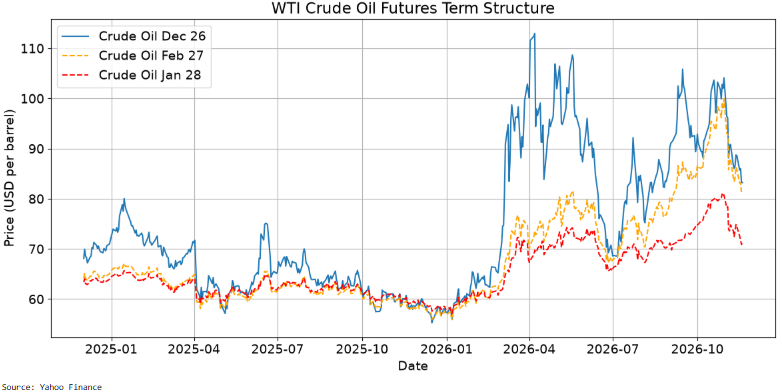
Crude prices plummeted once the Democrats swept Congress in the November 2026 midterms. We can see the stark effect the election has had on crude prices in the picture above. Both the current month and the front month have collapsed by over $20/barrel. Even the price 1 year from now fell in tandem.
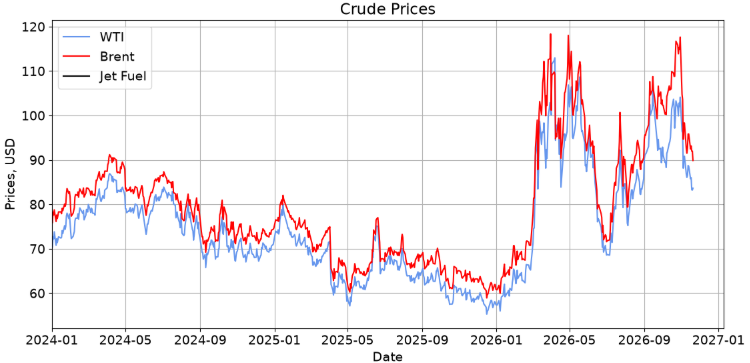
Immediately after the election, crude prices plummeted. Brent and WTI dropped by $20/BBL in hopes that the Democrats, who campaigned heavily for Iran, would accommodate Iran for attacking the United States, beating women for trying to campaign for women’s rights, and executing protesters to this day.
Crude prices still seem subdued even though geopolitics continue to worsen. But why did they fall? Fundamentals have not changed. Crude storage levels are roughly the same as they were when the Democrats swept the Republicans, the wars in the Ukraine and Iran are actually heating up, and prices of products are not coming down either.
Geo Politics
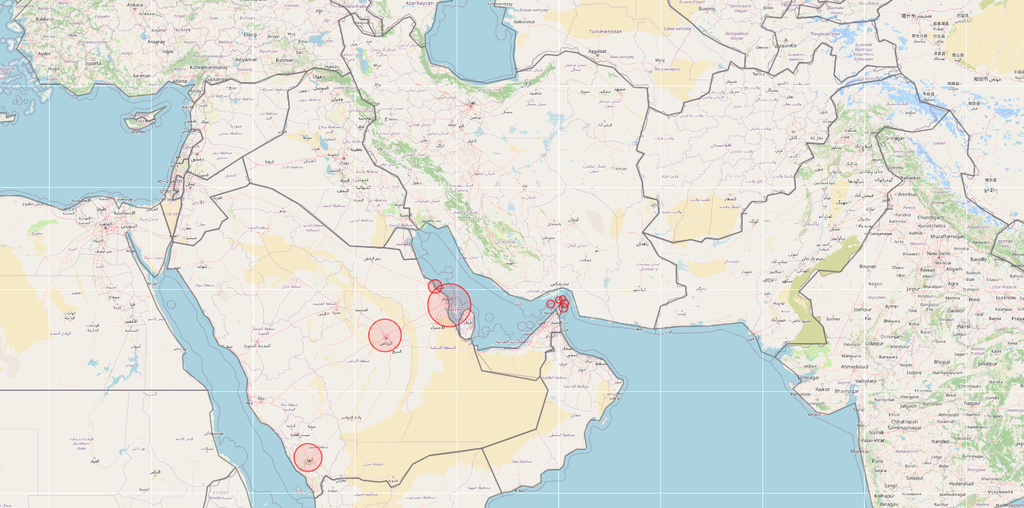
Prices have fallen even though Iran and its proxies have stepped up attacks across the Middle East. Attacks on civilians across Saudi Arabia have continued from Yemen. King Abdullah Financial District and the King Kahlid International Airport in Riyadh have been attacked by Iran. Iran has also attacked the SADAF Petrochemical Complex in Jubail and the King Khalid Air Base in Khamis Mushait as well by leveraging their proxies in Yemen. These attacks started after Iran had a flight from its territory to Yemen, which likely unloaded Iranian Quds Force members and weaponry. The Houthis have also made huge progress in the civil war in Yemen which means that the Saudi backed government looks to be on its last legs.
Iran has also stepped up attacks on vessels moving crude and petroleum products. 8 tankers have been attacked by Iran as they try to transit through Oman’s southern route in the Strait of Hormuz. Some of the tankers have hit naval mines while others have been hit by projectiles causing an environmental catastrophe.
Iran has also stepped up attacks on the United States. Bahrain, which holds a large American military base, has been attacked by Iran. Normally a country attacking the United States would be headline news but the media appears to ignore these attacks. Crude prices are still low compared to the impacts of these events in previous years despite Iran’s attacks on the United States, sinking vessels carrying crude in the Strait of Hormuz, and attacks on civilians throughout the region.
Democrats seem intent on allowing Iran to continue to attack the US and its allies but how long can this go on without a response from the United States? We cannot allow Iran to get a nuclear weapon when they attack civilians of countries that do not show any indication of attacking them and Iran seems emboldened by the recent midterm results.
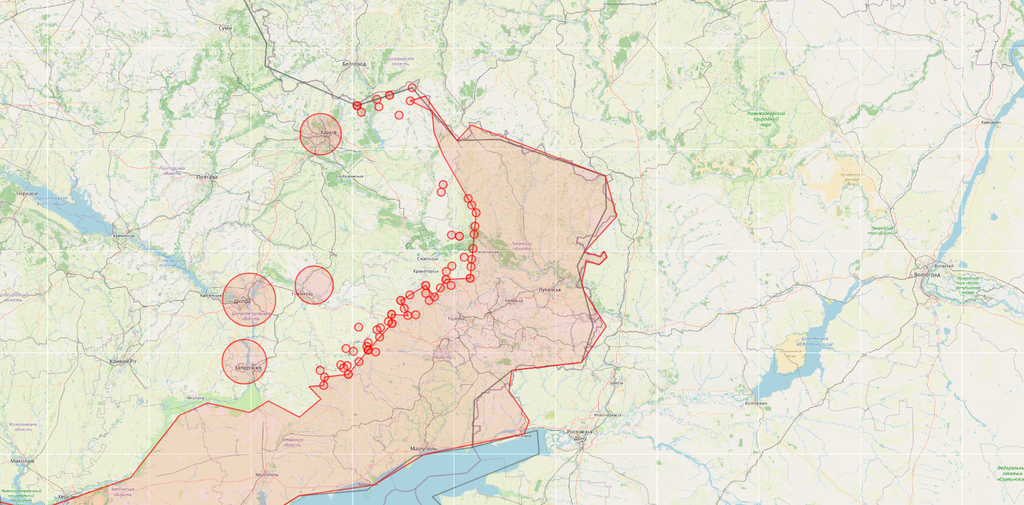
Russia also continues to inch across the eastern part of Ukraine while churning through tens of thousands of soldiers. The Russian army is bombarding the Ukrainian military along its eastern front. Hundreds of daily swarms of drones, vacuum bombs, pepper spray and human wave attacks are testing the outnumbered Ukrainian military. But they continue to hold up as Russia makes small gains to capture the factories and mining areas in Donbas.
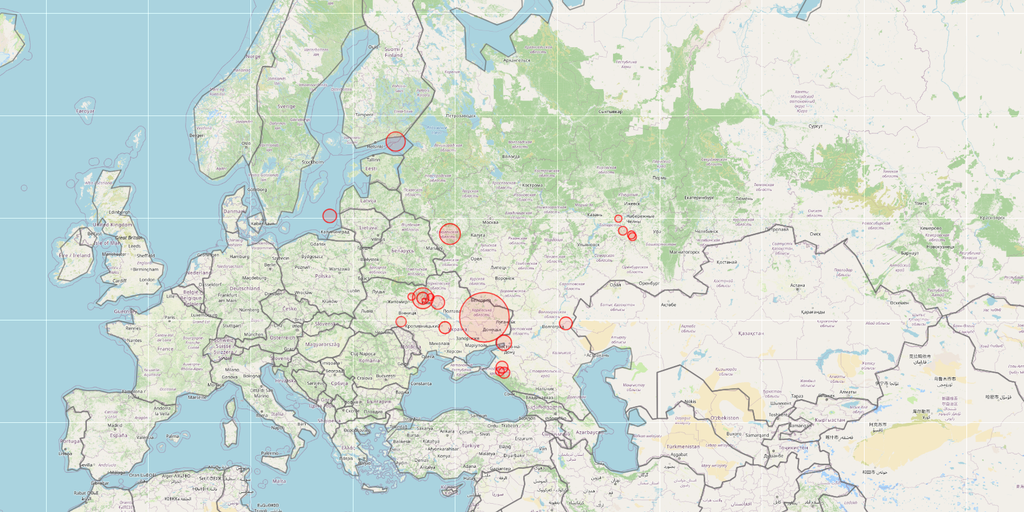
Russia continues to decimate Ukrainian cities with missiles and drones so numerous it’s tough to quantify but the Ukraine is attacking chemical facilities and pump stations across Russia. They are also bringing the war to the Baltic Sea in the northwest.
The Russian/Ukrainian war and the wars in the Middle East appear to have no end in sight and should not have an impact on crude prices which indicates that the drop in crude prices may be temporary.
Fundamentals
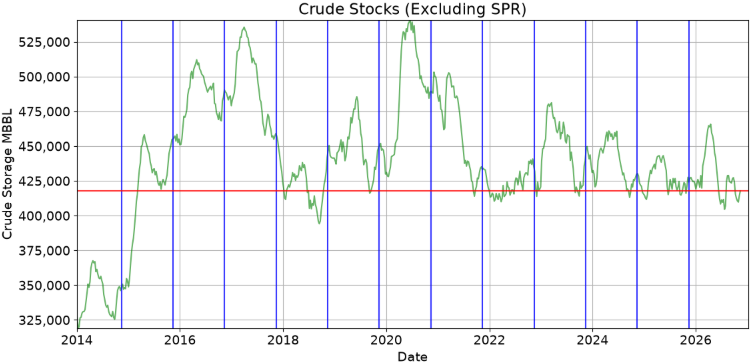
Above is a look at crude storage with the exception of the SPR. The intersection of the blue and red lines is a comparison of storage levels compared to this day in previous years which filters out the noise of the cyclical nature of the industry. Crude storage is cyclical and will swing up and down depending on the time of year and which refineries are going into turnaround at any given point.
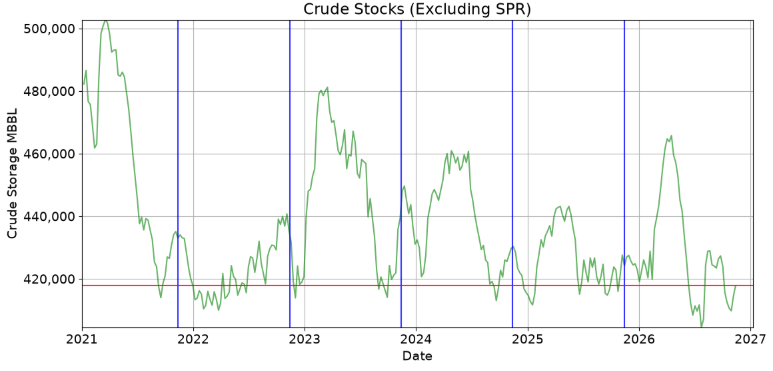
The summer driving season is over and fewer people are getting in their cars to travel across the United States but fundamentals have not changed much. We can see that storage was higher from 2021 to 2025 and that crude storage usually drops slightly before jumping back up at the start of the new year.
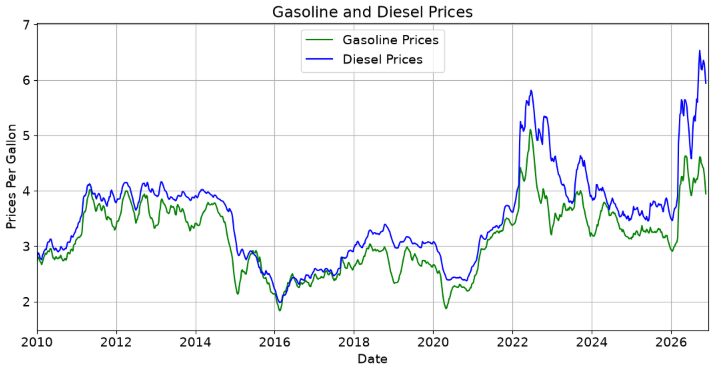
We have seen a drop in gasoline and diesel prices since the election but they are still near record highs. We would expect a delayed drop in prices of products about 2 weeks after crude prices drop due to the time it takes crude to get to the refineries. But these refineries all have long-term contracts. They buy crude months in advance at set prices and rarely rely on spot prices. The drop in crude prices will hurt producers like Diamondback but it may not change the profit margin which relies on the price of crude negotiated months before it’s pumped and the crack spread.
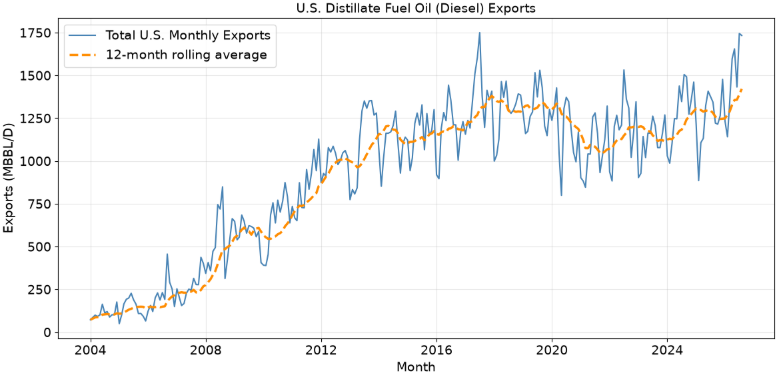
One thing that is driving high diesel prices is exports out of the United States. The US is an export powerhouse even compared to juggernauts like Russia, Saudi Arabia and even Iran, which finds a way to beat sanctions. All three of the countries have had interruptions to their exports due to recent attacks. Russian energy infrastructure has been decimated in 2026 as attacks from the Ukraine have paralyzed over 55% of Russia’s refineries. Ukraine does not appear to have backed off attacks on Russia’s refineries as they attacked the biggest refineries only a few weeks ago. Even if the West is not officially importing Russian products, they still have to compete with China and India for demand and when a powerhouse like Russia gets knocked offline, prices skyrocket.
President Trump has touted that many vessels have made it through Strait of Hormuz. In the past week independent media have reported that vessels have been getting hammered. This means that prices for products and crude will likely go up at least for Middle East buyers as Middle Eastern nations will struggle to get their crude out of the Persian Gulf.
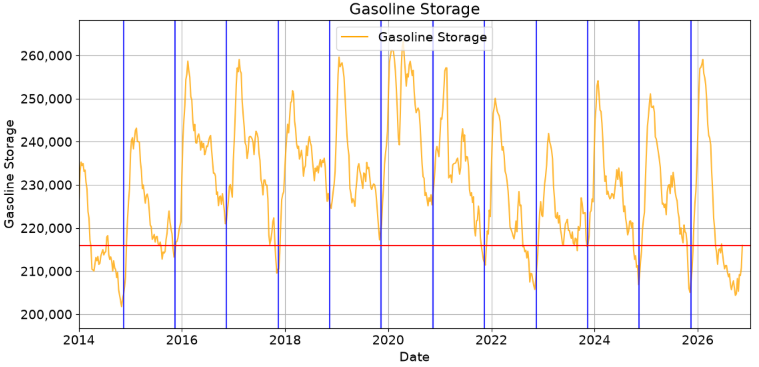
Again, the intersection of blue and red lines above filters out the cyclical nature of the industry. We can see for this time of year in previous years gasoline storage has been roughly in line with previous years, at least since Covid. Gasoline storage is likely to rise now that refiners are out of turnaround and the summer driving season is done. We can see that gasoline prices have dropped substantially but diesel prices remain high.
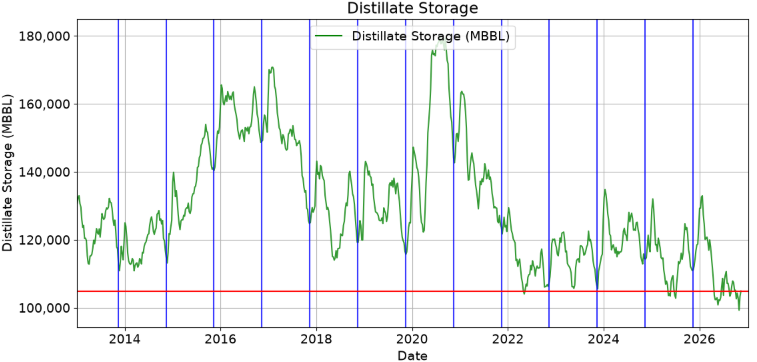
Diesel storage is still low for this time of year but if the past is prologue, diesel storage is likely to jump. Looking back to the end of 2025, we can see that after this time of year diesel storage rises. The same happened in 2024, 2023, and 2022. If Congress or President Trump pushes for a 15 day export ban we would see diesel storage jump by approximately 25 million barrels putting storage back into a normal range.
A couple of quick points before you take the contrary view. Refiners have long-term deals. Refiners have barrels pointed at them and pipeline companies often don’t have the storage capacity or attempt to dissuade shippers from holding barrels month over month unless they pay for storage. This means the volume has to keep flowing. Export capacity is already maxed out so crude storage could possibly go up. But refiners would have to continue to process the barrels that keep coming to them and their long-term contracts almost guarantee they will process these barrels even if there is an export ban.
Forward Looking Indicators
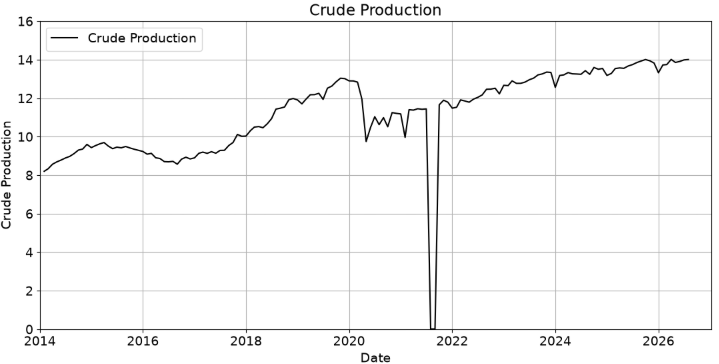
Crude production is bumping up against the record of 14 million BPD of crude production set in April 2026. There are several indicators of crude production that include drillable land, crude prices, rig counts, DUC counts, and frac spreads.
Investing in production has to have a long-term horizon. Having to get landmen to go out and get mineral rights, accountants to file permits with the Railroad Commission, schedule drilling rigs and frac crews independently of one another in the area to prevent kickbacks while drilling is a long and complicated process. Then producers have to flow out all the sand and make sure the wells are not too gassy. This makes the horizon of the whole process extremely long.
We have already seen that crude prices are still high enough for many producers to make money. Most large producers make money above $40/BBL but some can make money above $35/bbl. No matter their breakeven rate, $80/BBL is more than enough for producers to make money. But let’s look at the rest of the indicators.
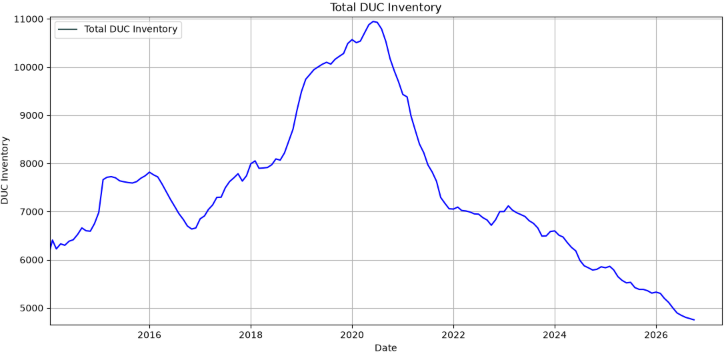
DUC inventory in the US is extremely low. You naturally have some DUCs as you have to drill up a field before you frac it to prevent kickbacks when drilling. If drillers see a frac crew anywhere in the area they have to stop drilling and shut in the well immediately to prevent catastrophic consequences.
Also some companies do count a well that collapsed while drilling the production leg of the well as a DUC. While some may not count DUCs with collapsed production legs, this would be a DUC since the surface and the intermediate wells are both drilled and set. It’s easier to drill another production leg and just kick off and go above or below the collapse than having to go through the processes above and drill a new well.
And having a high DUC inventory allows companies to maintain essentially free storage underground as they can just complete these wells anytime in the future. But no matter what your definition is, DUC inventory is well below normal which is not a strong indicator that crude production will continue to peak in the future.
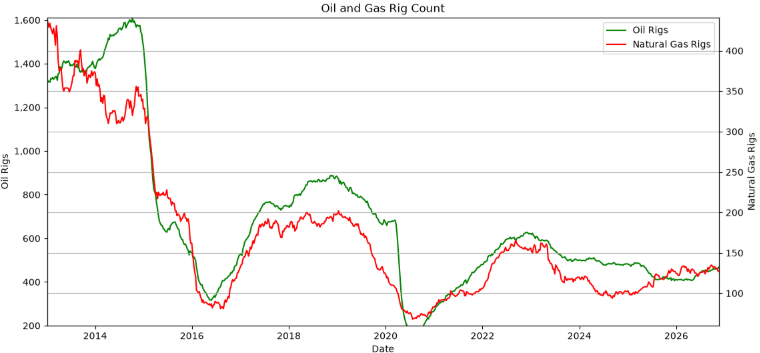
The Baker Hughes rig count shows that oil rigs, on the left axis, and gas rigs, on the right axis, have not varied considerably since bouncing back from Covid. Again, this is a long-term outlook as it takes time to permit a field and then schedule a drilling rig to get across lease roads. This could be an indication of efficiencies that come from drilling thousands of wells with rigs that are being automated but I don’t understand how efficiencies can make up for a loss of 30% of rigs since Covid.
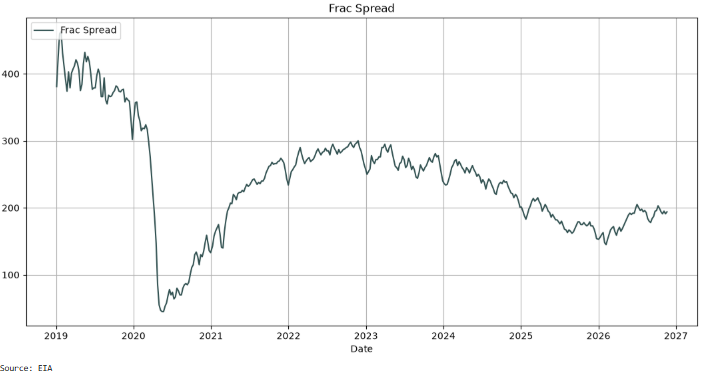
The frac spread has jumped from the low spot in 2026 but is down considerably from 2019 and even from the peak after Covid. Again, fracing companies have developed efficiencies but production companies have been extremely constrained on their investments to develop their fields which indicates that they are not fighting for market share while Russia and the Middle East deal with their turmoil.
Production companies are also factoring in the effect of electric vehicles on gasoline and diesel demand. As more electric vehicles consume electricity generated by solar, natural gas and coal to power their vehicles, they will consume less gasoline or diesel. This will especially be true as self-driving electric big rigs are hitting the road.
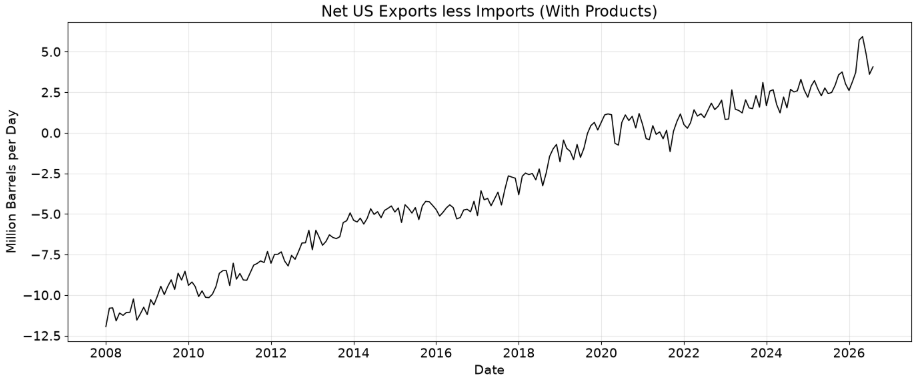
For now, crude and product exports will remain near record highs, and this will likely keep prices elevated. However, the drop in crude prices following the midterm elections does not appear to reflect any meaningful improvement in the underlying fundamentals. Storage remains relatively tight, production growth is showing signs of constraints, and geopolitical risks continue to threaten supply across the Middle East and Russia.
The market appears to be pricing in a much more optimistic outlook than the physical oil market would suggest. If these geopolitical disruptions continue and exports become increasingly constrained, crude and product prices could quickly move higher again. The question is not whether the current price decline is justified by improving fundamentals, but how long the market can continue to ignore the risks to global supply.